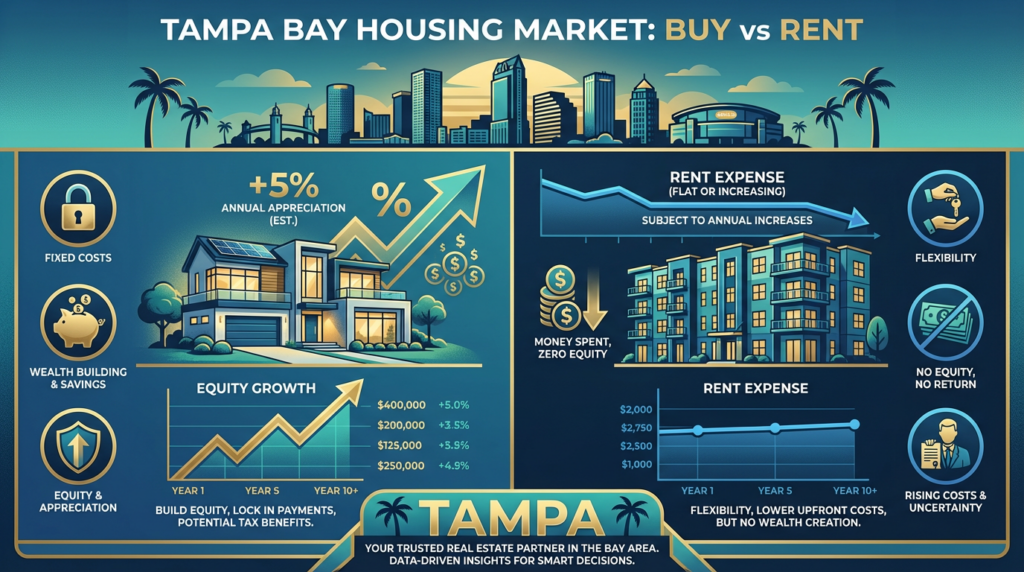
Tampa Buy vs Rent and Why Buying Still Wins for Long Term Wealth
The Tampa buy vs rent conversation has intensified as headlines point out that renting can feel cheaper than buying on a monthly basis. While that comparison is directionally accurate in the short term, it misses the bigger picture. When you compare Tampa to the broader U.S. housing market and evaluate outcomes over a full ownership cycle, buying still remains one of the most effective long term wealth building strategies available to Tampa buyers.
Unlike many overheated coastal markets, Tampa sits in a rare middle ground where demand, demographic growth, and constrained supply continue to support ownership advantages over time.
How Tampa Buy vs Rent Compares to the National Market
On a national level, most major metros currently show a meaningful gap between renting and buying. In many cities, buyers need significantly higher income to purchase than to rent, often without the same upside potential. Tampa does require higher income to buy than rent today, but that spread is smaller than in many peer markets.
More importantly, Tampa differs in three critical ways:
First, population growth remains structurally strong. Tampa continues to attract new residents from higher cost states who bring purchasing power with them. That demand supports long term price stability and appreciation.
Second, replacement costs continue to rise. New construction costs in Tampa are increasing due to labor, materials, insurance, and land constraints. Over time, existing homes benefit from this upward pressure.
Third, Tampa has not reached the same affordability ceiling seen in markets like Miami, Los Angeles, or New York. That gives it more runway for gradual, sustainable growth rather than boom and bust cycles.
Why Monthly Cost Comparisons Miss the Point
The Tampa buy vs rent debate often stops at monthly payments. That approach ignores how ownership works as a wealth building tool.
Rent is a pure expense. Each payment resets to zero.
A mortgage behaves differently. With each payment, you reduce principal, build equity, and hedge against future housing costs. Even modest appreciation compounds meaningfully over time when combined with amortization.
In Tampa specifically, rents have shown volatility tied to migration surges. Ownership smooths that risk by locking in housing costs while wages and inflation rise.
Equity Growth Is the Hidden Advantage of Buying in Tampa
One of the most overlooked benefits in the Tampa buy vs rent equation is equity acceleration. Early in a loan, principal reduction feels slow. Over time, it accelerates.
In a market like Tampa, where long term appreciation trends have historically outpaced inflation, equity growth becomes a forced savings mechanism. This is especially powerful for buyers who plan to hold for seven to ten years or longer.
That equity can later be leveraged for move up purchases, investments, or lifestyle flexibility. Rent offers none of those options.
Tampa’s Demographics Favor Long Term Ownership
Tampa’s economic profile supports ownership more than many realize. Job growth across healthcare, logistics, defense, and professional services creates income durability. Combined with inbound retirees and remote workers, this builds a wide buyer base across price points.
Markets that reward long term ownership share one trait: persistent demand from multiple buyer segments. Tampa checks that box.
New Construction Strengthens the Ownership Case
New construction plays a unique role in Tampa. As build costs increase, today’s buyers effectively lock in tomorrow’s replacement cost discount.
This matters long term. When supply cannot be cheaply replaced, existing homes gain relative value. That dynamic favors ownership over renting, particularly in master planned communities and infill locations.
Inflation Protection Is Often Overlooked
Rent adjusts with inflation. Mortgages do not.
Over long holding periods, inflation quietly erodes the real cost of fixed mortgage payments. In contrast, rents reset to market levels. Tampa’s growth trajectory makes this inflation hedge especially relevant.
The Real Question Buyers Should Ask
The Tampa buy vs rent decision is not about whether renting is cheaper this year. It is about which option positions you better over the next decade.
For buyers who value flexibility over stability, renting can make sense short term. For buyers focused on long term wealth accumulation, cost control, and equity growth, Tampa remains one of the more compelling ownership markets in the country.
FAQs
Is Tampa buy vs rent better for long term wealth?
Yes. Tampa buy vs rent comparisons favor buying over long holding periods because ownership builds equity, protects against rent inflation, and benefits from long term demand growth. Monthly rent savings often disappear when appreciation and principal reduction are considered.
Why does Tampa look different from other U.S. markets?
Tampa combines population growth, constrained supply, and rising replacement costs. Many U.S. metros have higher prices without the same growth runway, making Tampa more favorable for long term buyers.
Does renting ever make sense in Tampa?
Renting can make sense short term for flexibility or lifestyle reasons. It becomes less effective for long term wealth because rent does not convert into equity or future leverage.
How long should buyers plan to hold in Tampa?
Most buyers see ownership advantages after five to seven years. Longer holds amplify equity growth and inflation protection, especially in Tampa’s growth driven environment.
What type of buyers benefit most from buying in Tampa?
Buyers with stable income, long term plans, or interest in future move up or investment opportunities tend to benefit most from ownership in Tampa.
